Held on the same day as Spain’s opening FIFA World Cup 2026 match against Cape Verde, which ended in a 0-0 draw, the event brought together representatives from FIFA, the NFL, FC Barcelona, the Atlanta Falcons, MLS, Telemundo, The Coca-Cola Company, and other leading organizations to discuss the future of the global sports industry.
The forum will return to Madrid on November 6, 2026, bringing together global leaders from the worlds of sports, business, media, technology, and government.
ATLANTA, June 15, 2026 — The Spain-U.S. Chamber of Commerce, in collaboration with the Metro Atlanta Chamber, hosted the Business & Sports Summit on June 15 in Atlanta. The international forum brought together some of the most influential leaders in the global sports industry during FIFA World Cup 2026.
The event coincided with the presence of the Spanish National Team in Atlanta for its opening World Cup match against Cape Verde, which ended in a 0-0 draw before thousands of fans at Mercedes-Benz Stadium. The occasion transformed Atlanta into one of the principal gathering points for institutions, businesses, and media organizations connected to Spain throughout the tournament.
The day began with an institutional welcome at the Metro Atlanta Chamber headquarters, featuring remarks from Ángeles Moreno Bau, Ambassador of Spain to the United States; Andre Dickens, Mayor of Atlanta; Lizann Grupalo, Deputy Commissioner for International Trade at the Georgia Department of Economic Development; Katie Kirkpatrick, President & CEO of the Metro Atlanta Chamber; and Mónica Vázquez, President of the Spain-U.S. Chamber of Commerce.
Speakers highlighted the growing role of sports as a catalyst for economic development, international investment, tourism, innovation, and cross-border collaboration, particularly as major global events increasingly serve as platforms for business and diplomatic engagement.
FIFA World Cup 2026 as a Global Economic Catalyst
The Summit’s opening panel examined how FIFA World Cup 2026 is reshaping the business of sports, bringing together leaders from FIFA, Telemundo, and The Coca-Cola Company to discuss the intersection of media, technology, sponsorship, and fan engagement.
A recurring theme throughout the conversation was that the future of sports will be increasingly fan-centered, with organizations leveraging data, technology, and artificial intelligence to deliver more personalized experiences while preserving the emotional connection that makes sports unique.
Romy Gai, Chief Business Officer of FIFA, explained that the value of fan data begins with understanding the distinct communities that follow the game around the world and using that knowledge to deliver relevant content through the right language, platform, and format. Looking ahead, he identified the ability to understand and optimize the complete fan journey as one of the industry’s greatest opportunities, noting that media consumption patterns continue to evolve rapidly toward streaming and digital platforms.
José Cancela, President of Telemundo Station Group, emphasized the growing strategic value of Hispanic audiences in the United States and underscored the continuing strength of premium sports content in an increasingly fragmented media environment. While acknowledging the transformative potential of artificial intelligence, he predicted that transparency in the use of consumer data would become one of the defining issues for media companies in the years ahead, while reiterating that “content remains king.”
Marcelo Boffi, Chief Operating Officer for North America at The Coca-Cola Company, highlighted how major sporting events create opportunities for brands to build long-term relationships with consumers that extend well beyond a single match or tournament. Discussing the future of sponsorship and engagement, he remarked that “the biggest transformation ahead will be how the sports ecosystem embraces artificial intelligence to create highly personalized experiences for consumers while maintaining trust and transparency.”
From FIFA’s regulatory perspective, Emilio García Silvero, Chief Legal and Compliance Officer, reflected on the complexity of organizing the 2026 FIFA World Cup across the United States, Mexico, and Canada—the first-ever tournament shared by three nations. With the competition expanding to 48 teams and 104 matches across 16 host cities, he noted that delivering such a global event requires unprecedented coordination in areas such as security, transportation, and taxation. García Silvero stressed that successful execution depends on strong partnerships with governments and local institutions, working hand in hand with local, state, and national authorities to ensure a seamless experience for fans, teams, sponsors, and stakeholders. He concluded by emphasizing football’s unique ability to transcend borders and cultures, adding that “this is the magic of football: it brings people together, wherever they are.”
The panel concluded with broad agreement that the future of sports will be defined by three interconnected forces: a relentless focus on fan experience, the growing role of data and personalization, and the importance of collaboration among sports organizations, governments, media companies, and corporate partners to successfully deliver events on a global scale.
The International Expansion of Major Sports Leagues
The second panel focused on the globalization of professional sports and featured representatives from the NFL, FC Barcelona, Major League Soccer, and AMB Sports & Entertainment.
While each organization operates under a different business model, participants agreed that international expansion is no longer simply a branding exercise. Instead, global growth has become a fundamental business strategy centered on fan development, media rights, sponsorship opportunities, and long-term enterprise value.
Rich McKay, CEO of AMB Sports & Entertainment, explained that one of the NFL’s greatest strengths has been its commitment to competitive balance. He argued that the league’s long-term success is built on two fundamental pillars: the equitable sharing of national revenues among all franchises and a parity-driven system designed to keep competition balanced. As an example, he noted that the team finishing last each season receives the first pick in the NFL Draft, a mechanism intended to strengthen weaker teams and maintain league-wide competitiveness. According to McKay, these principles have enabled every franchise to remain relevant and competitive, helping create a league that generates sustained interest from fans year after year.
Representing the NFL’s international operations, Rafael de los Santos, General Manager of NFL Spain, explained that global audiences increasingly demand authentic and meaningful competition rather than exhibition events. Reflecting on the league’s evolution abroad, he noted that “fans want the real thing,” which is why the NFL has focused on bringing regular-season games to international markets and building year-round engagement strategies that connect with local communities.
Jay Berhalter, Executive Vice President of Business Development at MLS, highlighted how Major League Soccer adopted many principles inspired by the NFL’s model to ensure long-term sustainability and competitive balance. Looking ahead to FIFA World Cup 2026, he described the tournament as a springboard for the continued evolution of soccer in the United States and an opportunity to further elevate MLS on the global stage.
Offering the perspective of one of the world’s most recognized sports brands, Bryan Bachner, Managing Director for the Americas at FC Barcelona, discussed how clubs are using technology to maintain meaningful relationships with supporters regardless of geography. Reflecting on the club’s digital strategy, he summarized FC Barcelona’s philosophy simply: “If fans cannot come to us, we must go to them.”
The panel concluded that the future of sports globalization will depend on an organization’s ability to create year-round engagement, develop local fan communities, and combine elite competition with authentic experiences. Whether through regular-season NFL games abroad, MLS’s development pathways, or FC Barcelona’s digital engagement strategy, participants agreed that sustainable growth begins with bringing fans closer to the sport.
Madrid and Atlanta as Global Platforms for Major Sporting Events
One of the highlights of the Summit was a discussion on how cities such as Atlanta and Madrid are positioning themselves as global destinations for major sporting events and the economic opportunities that follow. The conversation focused heavily on the historic NFL regular-season game that will bring the Atlanta Falcons and Cincinnati Bengals to Madrid’s Santiago Bernabéu Stadium this November.
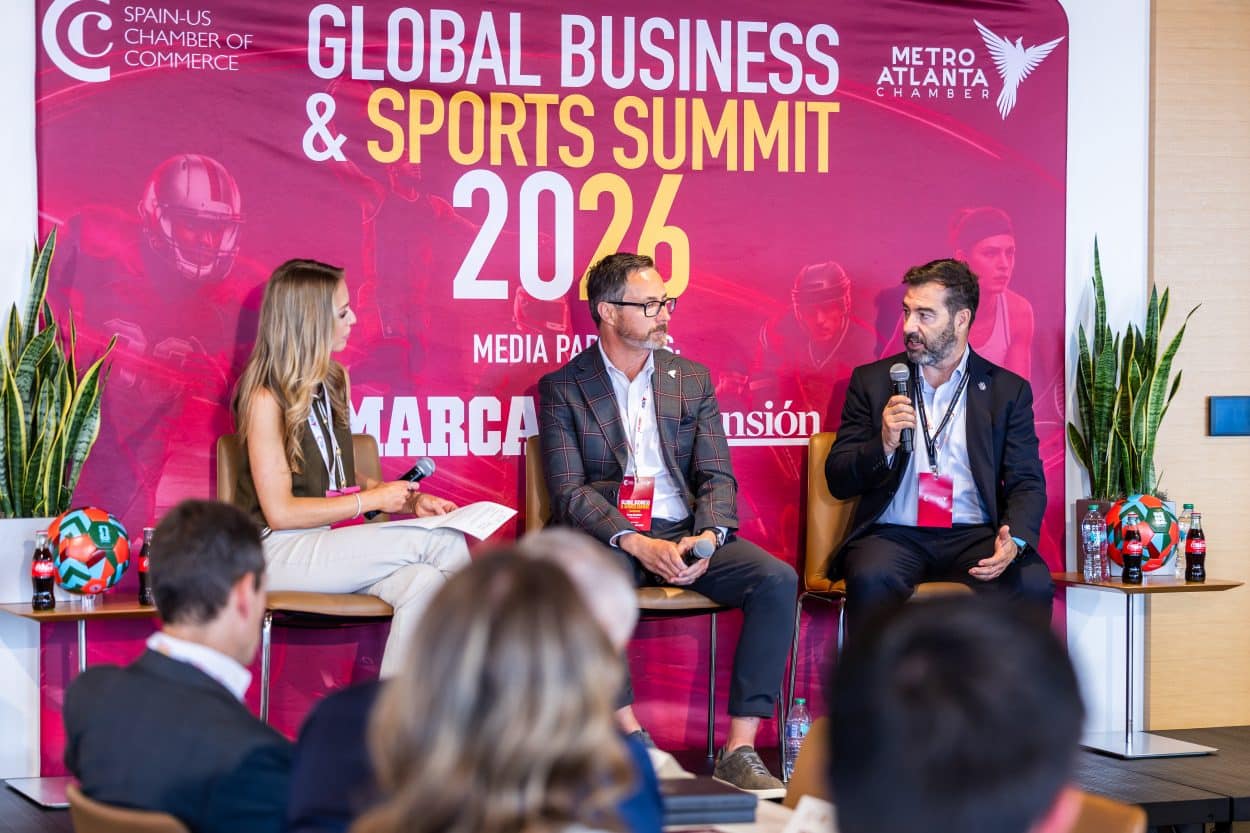
Rafael de los Santos, General Manager of NFL Spain, highlighted the league’s growing momentum in the Spanish market, pointing to the success of the first official NFL game at Madrid’s Santiago Bernabéu Stadium. He emphasized that the NFL’s appeal extends beyond the sport itself, combining football with entertainment, music, and lifestyle experiences. De los Santos added that the league is investing significant effort in creating content around the sport and finding ways to educate new audiences about the game, helping build a deeper connection with fans. He noted that the NFL’s goal is to become part of Spain’s daily sports conversation year-round, while building a long-term presence in the country by creating an experience that goes well beyond the field.
Greg Beadles, President and CEO of the Atlanta Falcons, offered an inside look at the operational complexity of staging an international NFL game while emphasizing the organization’s long-term commitment to fan development. For the Falcons, success begins with creating authentic relationships with supporters. As Beadles stated, “our most important KPI is fan acquisition. If we create meaningful relationships with fans and put them first, everything else follows.”
Both speakers identified flag football as one of the most important growth vehicles for the sport, particularly following its inclusion in the Los Angeles 2028 Olympic Games. They also agreed that international expansion succeeds when it combines elite competition, local engagement, cultural relevance, and a genuine commitment to growing the fan base over the long term.
The Growing Importance of Partnerships in Sports
The Summit concluded with a discussion on the increasing role of corporate partnerships, sponsorships, private capital, and community engagement in shaping the future of the sports industry.
Panelists agreed that modern sponsorships are no longer measured by logo placement alone. Instead, successful partnerships are increasingly built around shared values, authentic storytelling, meaningful community impact, and the ability to create memorable experiences for fans.
Morgan Shaw Parker, President and CEO of the Atlanta Dream, explained that the organization has intentionally prioritized community impact as a central pillar of its business strategy. She highlighted initiatives focused on financial literacy, women’s empowerment, and social equity, emphasizing that “our responsibility goes beyond basketball; it is about creating lasting impact in the communities we serve.”
Andrew Saltzman, President of Business Enterprise and Chief Commercial Officer for the Atlanta Hawks and State Farm Arena, discussed how the organization has shifted from pursuing a large number of sponsors to cultivating deeper relationships with fewer partners. Guided by the mantra “True to Atlanta,” he explained that long-term success comes from aligning with organizations that share the team’s values and commitment to the community.
From the corporate perspective, Dale Jacobe, Sponsorship Strategy Manager at Georgia Power, explained that investments in major sporting events such as FIFA World Cup 2026 are closely tied to economic development objectives. He noted that sponsorships provide an opportunity not only to increase brand awareness but also to demonstrate how companies contribute to making communities stronger places to live and work.
Stephanie Bates, Vice President at U.S. Soccer, highlighted the critical role that corporate partners play in helping the federation expand access to the sport and create new fan experiences. She pointed to initiatives such as the federation’s new National Training Center in Atlanta and fan engagement platforms that would not be possible without long-term collaboration between sports organizations and private-sector partners.
The discussion concluded that while organizations cannot control what happens on the field, they can control the quality of the fan experience, the strength of their community relationships, and the authenticity of their partnerships. Across the sports industry, these factors are increasingly becoming the foundation for sustainable growth and long-term value creation.
Looking Ahead: The Business & Sports Summit Heads to Madrid
The discussions throughout the day reinforced a common conclusion: major sporting events have evolved far beyond competition on the field. Today, they serve as powerful engines for economic growth, tourism, infrastructure investment, urban development, international visibility, and business creation.
From the FIFA World Cup and the NFL’s international expansion to the growth of global club brands and emerging sports properties, panelists agreed that cities and regions that successfully leverage sports as an economic development tool will be better positioned to attract talent, investment, and international attention in the years ahead.
Building on the success of the Atlanta edition, the Spain-U.S. Chamber of Commerce announced that the next Business & Sports Summit will take place in Madrid on November 6, 2026, ahead of the NFL regular-season game between the Atlanta Falcons and Cincinnati Bengals at Santiago Bernabéu Stadium on November 8.The Madrid forum will once again bring together leaders from the worlds of sports, business, media, technology, and government to continue exploring the growing role of sports as a platform for economic development, innovation, and international collaboration.
From our Media Partners:
Expansion: https://www.expansion.com/directivos/deporte-negocio/2026/06/16/6a3166cee5fdeaee228b459e.html