
From legal requirements to leases, contracts and employee coverage, understanding the U.S. insurance landscape – and Florida’s unique considerations – can help international companies establish operations with greater confidence
For companies expanding into the United States, the launch checklist can be extensive: forming the U.S. entity, securing banking and accounting relationships, negotiating a lease, hiring employees, arranging payroll, signing customer contracts and navigating state and local licensing requirements. Insurance belongs on that list early — not simply when a landlord, lender or customer asks for a certificate of insurance.
The U.S. insurance environment can be complex without the right guidance. Insurance is regulated primarily at the state level, and a company’s obligations can also be shaped by its industry, contracts, workforce, vehicles, property and actual business activities. The same basic principles apply throughout the country, but requirements and market conditions can differ significantly from one state to another. Addressing those issues early can prevent delays, unexpected expenses and coverage gaps as the U.S. operation begins to grow.
Start with the question: “What are we required to carry?”
There is no single insurance package required for every U.S. business. Requirements vary by state and depend on the company’s industry, workforce, vehicles, licenses and activities. Workers’ compensation is a good example. In Florida, non-construction employers generally must secure workers’ compensation coverage once they have four or more employees, while construction employers generally must carry coverage when they have one or more employees, subject to state rules and available exemptions.
Companies entering a new state should therefore review local requirements before employees begin work. In Florida, out-of-state employers can become subject to Florida workers’ compensation requirements when employees perform work in the state, and construction companies face particularly specific rules. Similar state-by-state differences exist throughout the country.
From legal requirements to contractual requirements
Businesses that own or operate vehicles must also review the financial-responsibility and insurance requirements of the states in which they operate — and, just as importantly, determine whether minimum legal limits adequately reflect the company’s actual exposure.
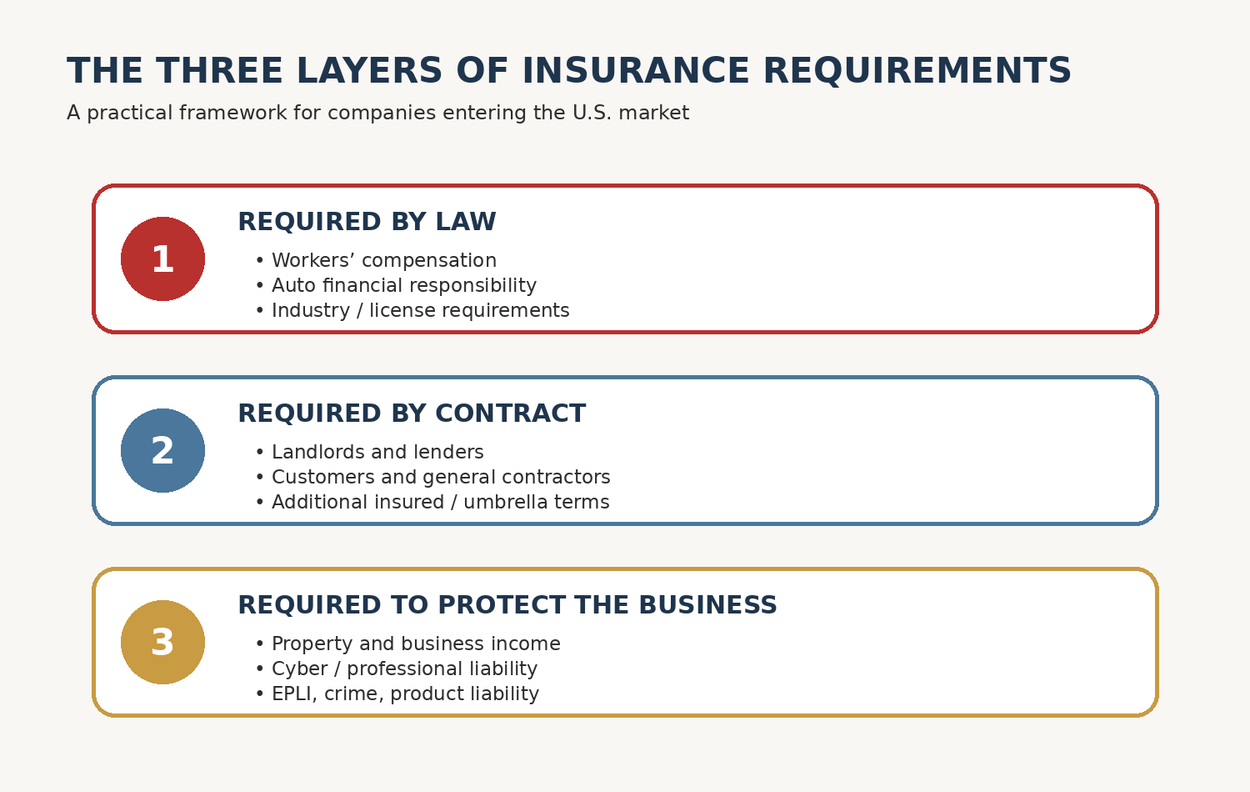
Your contracts may require more insurance than the law
For many international companies, this is where the U.S. insurance environment can become unfamiliar. A business may be fully compliant with applicable law and still be unable to sign a lease, begin a project or satisfy a customer because its insurance program does not meet contractual requirements.
A commercial lease may require general liability insurance, property coverage, business income protection and specific limits. A general contractor may require workers’ compensation, commercial auto, general liability and umbrella coverage before a subcontractor can enter a jobsite. A major customer may ask to be named as an Additional Insured, require Primary and Non-Contributory wording or request a Waiver of Subrogation. Banks and lenders can impose their own insurance requirements as part of financing arrangements.
These are not merely certificate-of-insurance issues. The underlying policy must be structured to support the contractual obligations. Reviewing insurance provisions before signing an agreement gives the company time to determine whether the required coverage is available, appropriate and economically reasonable.
Legal compliance is only the starting point
A new U.S. business should also ask what could materially disrupt the operation even if no law or contract specifically requires insurance. A retailer or restaurant may need property and business income coverage. A manufacturer or distributor may have product-liability and inventory exposures. A consulting, technology, marketing or professional-services company may need Errors & Omissions coverage. Any company that stores sensitive information, accepts electronic payments or depends on technology should evaluate cyber risk.
Employment Practices Liability can become increasingly important as the U.S. workforce grows. Crime coverage may protect against employee theft or funds-transfer fraud. Umbrella or Excess Liability can provide additional limits above primary liability policies. The correct program is driven by the business model — not by a generic checklist.
Understanding the U.S. insurance landscape — and Florida’s unique market
Many of the same insurance principles apply throughout the United States, but requirements and market conditions vary by state. Florida, in particular, has a unique insurance environment compared with many other states, making local market knowledge especially valuable for companies establishing operations here.
That complexity should not be viewed as a barrier to doing business. With an experienced insurance advisor involved early, legal, contractual and operational requirements can be identified and addressed as part of the market-entry process. The goal is to understand the company’s exposures, build an appropriate program and avoid unnecessary surprises as operations begin and grow. For international companies, the right advisor can also help translate unfamiliar U.S. insurance terminology and requirements into practical business decisions. A straightforward office operation may have very different needs from a contractor, manufacturer, restaurant, importer or technology company. Starting the conversation early generally provides more time to evaluate options and coordinate insurance with leases, contracts, hiring and other launch decisions.
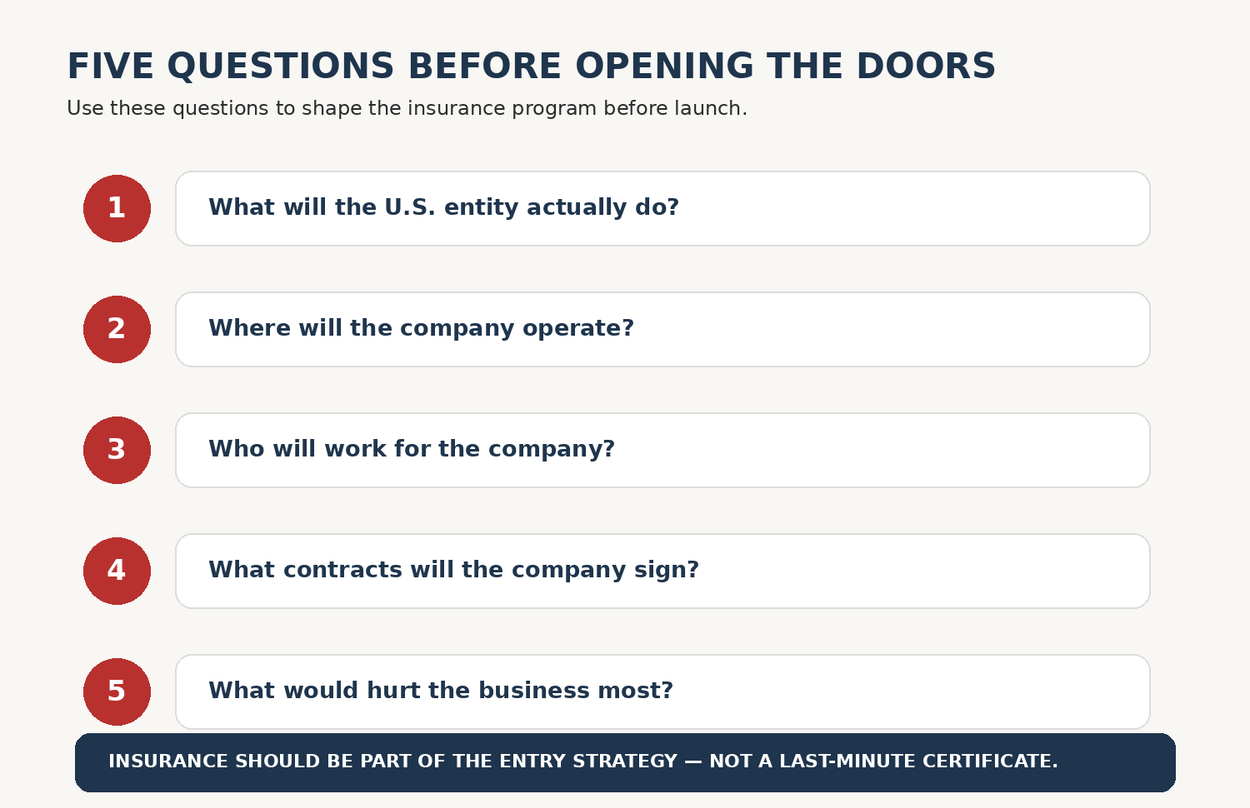
Make insurance part of the U.S. entry strategy
The most effective time to design an insurance program is before the first certificate is urgently needed. When insurance is reviewed alongside the lease, hiring plan, contracts, vehicles, property and operating model, it becomes part of the company’s strategy rather than an administrative obstacle. For Spanish and other international companies entering the United States, the objective should not simply be to purchase the minimum amount of insurance. It should be to understand what is legally required, what business partners will require and what the company genuinely needs to protect its investment. With the right guidance, the complexity of the U.S. insurance landscape can be managed confidently and the program can evolve as the company’s U.S. presence grows
ABOUT THE AUTHOR
Rolando Rouco Jr. is President & CEO of RRJ Insurance Services of Florida Corp., a member of the Spain-U.S. Chamber of Commerce. With more than 30 years of insurance industry experience, he advises businesses on commercial insurance and risk management, including companies establishing or expanding operations in the United States.